


Strategy to upgrade South Africa’s nursing profession!

A growing imperative – to implement a strategy to upgrade South Africa’s nursing profession!
Nursing is one of the most honorable professions, yet adverse conduct of poorly trained nurses is witnessed in South Africa’s hospitals and clinics on a daily basis. The local healthcare sector – both public and private — urgently needs more nurses with advanced nursing skills and leadership education, which in short calls for a long overdue shake-up of the nursing profession. A general consensus is held that the training provided by some nurse’s colleges fail to adequately prepare trainees in theoretical knowledge and expected outcomes (specialist theory and practical experience) necessary to execute relevant duties to a professional standard.
In 2012 the National Department of Health convened a nursing summit to address nursing challenges in the country. From that summit, Health Minister Aaron Motsoaledi appointed a ministerial task-team to develop a plan of action to address education and practice issues to rebuild and revitalize South Africa’s flagging nursing fraternity. The Minister launched the National Strategic Plan for Nurse Education, Training and Practice for 2012/13 – 2016/17. It is critical that South Africa’s healthcare system be brought up to standard by the time the National Health Insurance rolls out, to ensure that nurses are fully operational to address the country’s healthcare needs.
Lifelong Learning
The healthcare sector is regularly criticized for its lack of resources, inconsistent staff-patient ratios, poor management, long queues and waiting times, and overall lack of sanitation control. The plan focuses on fostering a culture of lifelong learning in an effort to attain high standards of professionalism and well-resourced practice environments for nurses and midwives. It also aims to boost strong leadership skills at all levels within the healthcare sector, including advanced clinical skills in mental health nursing, pediatric nursing and post-operatory nursing. Nursing is a lifelong educational commitment. Working nurses will be duty-bound to go back to school to constantly upgrade their credentials to gain greater employability, higher salaries, and explore diverse career options in fields like disaster response, emergency preparedness, and wellness promotion. While many leadership education programs do not require you to be a nurse, they do help refine communications skills; teach the fundamentals of healthcare economics; identify and harness resources; and relate critical thinking to problem solving.
SA Nursing Council at helm
Regulations affirm that all nursing colleges in the country have until 2015 to upgrade their syllabus and tertiary education methodology to meet the criteria to register as higher education and training institutions with the Council of Higher Education. This means about 300 operational nursing colleges will not only be regulated by the SA Nursing Council, but will also have to be declared higher education institutions in compliance with the provisions of the Higher Education Act (as amended in 2008). The qualifications of teachers and lecturers will be scrutinized. The expectation is that professional nurses on completion of their studies would be competent to run wards and teach junior nurses. Professional nurses must be trained to drive an ambulance, serve as an undertaker, and adapt to work proficiently in poorly equipped facilities, operate a generator, and practice transpersonal human care and caring to facilitate patient recovery. The intention of higher education is also to increase the number of nurses accredited to initiate anti-retroviral treatment without a doctor.
Retired Nurses’ Forum
In an effort to preserve task-specific expertise within the healthcare sector members of the Retired Nurses’ Forum agree to guide and mentor ward sisters, student nurses and new recruits to correct behavior that is observed as not professional, reinforce a personal approach to professionalism, and inspire excellence. Proficient retired nurses work in labour wards, primary healthcare services, port health at the airports, complaints line, hospital wards and intensive care depending on their area of expertise or where most needed.
Health Infrastructure
Trends in 21st Century nursing are increasingly driven by professionalization and specialization, wider use of technology without compromising the nurturing and human touch aspects of early nursing, and equal gender representation in the profession. Problems that provoke criticism must be promptly investigated and resolved. Calculated planning, development and management of human resources are critical facets to enhance the healthcare sector; its vital to verify how many nurses, doctors, physiotherapists, pharmacists are needed. Who pays them? What further training is needed? Where should they get training? What criteria determines the level of quality care? Is nursing a gender-bias profession? Nursing has traditionally been a female occupation but need not continue to be so; equal gender representation in the nursing profession is a crucial consideration. Equal numbers of male and female nurses should be trained to fully serve the nation.
Theory of Caring
Modern technology facilitates greater opportunities for nurses to provide increased comfort and care to their patient that was unimaginable a few decades ago. It has however created new problems: the caring and nurturing nurse, who in the beginning was an extension of family-centered nurse-patient healing, is often turned into a technician using sophisticated equipment. This theoretical detachment threatens to marginalize the human aspect of nursing; the modern dilemma is to find the balance between the core concept of personal care and the use of modern technology in professional nursing. The role of a professional nurse also involves taking pride in her work and reputation, and always taking steps to learn more, acquiring additional skills, and helping fellow nurses succeed.
Recruiting rural job seekers
South Africa needs more professional nurses. The department intends to recruit and train young unemployed people from rural areas who wish to become professional nurses. The expectation is that they would go back to their communities and be offered employment to make a difference. While many nurses might have undergone basic training as assistant nurses they are by today’s standards unemployable because they are under-qualified.
The burden of disease in South Africa is huge. HIV/AIDS in South Africa remains a prominent health concern and the impact on children has been vast. Large-scale communication campaigns to raise awareness of HIV and AIDS, counseling and testing, as well as broader treatment programs are sustained. About a quarter of Tuberculosis (TB) cases in Africa occur in South Africa, with more than 389,000 South Africans getting the disease annually. A concern is that TB cure rates have dropped significantly as a growing number of cases are emerging drug-resistant. Re-engineering primary health care (PHC) in the country involves intensifying health education programs to reduce people’s vulnerability to diseases, promote health and longevity, and reduce maternal and child mortality.
Every citizen deserves access to PHC
Primary Health Care means moving away from a curative health-care system towards programs that prevent diseases and promote optimal health. The goal is to reduce people’s vulnerability to diseases so that fewer depend on the healthcare system. The current healthcare system is slowly evolving into a new system built on a vision of health promotion, primary care and community-based home care, with hospitals still being a core pillar of the healthcare system but not its primary service. The strengths-based approach requires a new set of values that allow for innovative solutions to long-standing problems. It is about restoring the centrality of the nurse–patient relationship to promote wellness and to facilitate healing and in so doing, support professional nursing practice.
Words by Theresa Lutge-Smith (ecottage@gmail.com); nursing in South Africa is in crisis, with a third of nurses admitting they moonlight and half saying they feel exhausted at work. There is a severe shortage of nurses, leaving those in the system overworked.
Copyright 2013 : Achiever magazine
What Kind of Guy Are You?

He is independent and determined, and does what he wants when he wants!
Seeking validation from others about what kind of guy you are is not necessarily about gaining control. Movers and shakers of global conglomerates, innovative inventors and men of note did not achieve their formidable status by being sweet, tolerant and patient. Their formative years, from gawky adolescence to celebrating their birth year at age thirty, were fraught with yearnings to be accepted, admired, adored and acknowledged, not unlike the rest of the male population. Yet these achievers chose to live life with intent, kept their eye on the prize, threw caution to the wind, scoffed at doomsayers and soldiered on despite major intolerable waves of ignorant resistance. Theirs is a proud history of exploring life way beyond the normal parameters of mundane society, embracing the seemingly impossible in the midst of a vicious storm that threatens to destroy the fragile structure of what has already been painstakingly attained. These Rebels of Society acknowledge their success and standing in life as sacrifices worthy of their triumph. They have no regrets, only a wealth of tried and tested experience.
Every endeavour has its rewards. Young, vibrant males brave the unknown with eyes wide open, a heart filled with courage and optimism, and an attitude that is single-minded yet beckoning new awareness. The world needs more strong-minded visionaries who stand firm on their convictions; men, who turn their back on staid principles, and defy manipulative threats of imminent failure if they reject conformity. It’s a myth that in order to get ahead you must be a compliant team player and dance a slow tango with corruption and betrayal as your partner, or compelled into achieving fixed milestones within a 10-year plan like graduating cum laude, earning a six-figure income, signing up for membership to the right kinds of social club, starting a family, moving in the right circles, keeping healthy, and building that elusive nest egg to ensure a comfortable old age.
Finding your passion is everything. Every young man, even the warrior, stumbles upon challenges that make him feel insecure, stupid and a dismal failure. Don’t believe that every battle is easily won purely based on the audacious image he presents to the world. Despite his rogue exterior, good looks and style he does not earn favour with every woman he desires. A daily diet of rejection, limitation and ridicule nourishes his soul to nurture ever higher expectations of himself and an understanding of how cause and effect rally to make him stronger. Yet, on many occasions his dreams are crushed and need to be recycled, often reduced or reinvented. Disappointment rains daily on his scarred ego, making him more determined than ever to delve in the unfamiliar and the unknown.
A scarred ego is a badge of honour. To succeed in life you have to stand up and take some blows, to be a warrior. Yet, even brave warriors fall along the way, chip a tooth or break a limb, but they get up, brush themselves off and emerge victorious. His rogue public image masks a secret life that advances selective inner aspirations. He knows what he wants and searches relentlessly for opportunities to expand his knowledge about things often labeled peculiar and outrageous. He intentionally shuts his mind to the eternal mad chatter of the world and welcomes the inner-connectivity of Spiritual Awareness. While it’s not his intention to be viewed as rebellious, the growth process is often painful. And while not willfully looking for trouble, there’s an aura of danger about him. He is independent and determined; and does what he wants when he wants; and he expects to win. What kind of guy are you?
Words by Theresa Lutge-Smith (ecottage@gmail.com)
Customer complaints can be turned around!

Ever-changing consumer expectations necessitate that service providers continually reassess their product offerings, marketing tactics, and customer service. Even companies that boast minimal complaints from unhappy clients recognize that they need to regularly update their customer understanding to keep the process streamlined. They also need to identify fundamental changes in market environments and customer preferences if they are to avoid falling into the complacency trap of ‘business as usual’ in the face of dynamic change. However, even if a company makes every effort to market quality products and deliver exceptional customer service it’s not possible to please everyone all the time. Eleanor Roosevelt said it best with her quote,“Do what you feel in your heart to be right, for you’ll be criticized anyway. You’re damned if you do and damned if you don’t.”
When faced with challenging customer complaints a company’s first reaction is that their public image will be irreparably damaged. Although this might be a real possibility, negative feedback from customers should be viewed as a welcome wake-up call, an opportunity to renew their brand, maximize customer service, revamp their image and market focus, implement an annual employee-value survey and an ongoing staff training program, monitor consistency between departments, identify needed improvement in policies and procedures, keep senior management and stakeholders informed, explore new business opportunities, build customer loyalty and reinstate company ethics. In a bid to protect their reputation and maintain a competitive edge, many companies pinpoint what differentiates their products and services relative to their competitors in terms of price, product packaging, multiple product options, and quality of service options.
Common sense tells us that customer service is important to any company’s survival. We are hearing more and more complaints from customers about frontline staff who are surly, ill-informed, and unable to resolve a query or return; complaints are met with resistance and excuses, and worst of all, customers are accused as being technologically inept or ignorant about how the company in question operates. Surely customers, the lifeblood of any organization, should not get the short end of the stick if sales and service people are agitated from an unrelated issue or have poor people skills. With so many buying choices today managing customer expectations in a polite and constructive way can make a huge difference to whether a customer remains loyal to a company or not. Bear in mind that satisfied customers might tell 3 friends about their positive business experience, while disgruntled customers have the power (especially using today’s social media tools) to ‘spread the word’ to at least 3-thousand other people.
When a company receives a customer complaint its staff has two options: dismiss the problem as trivial or pull out all the stops to rectify matters. When dealing with a difficult customer make sure you stay calm and polite. Allow the irate customer to vent; just by listening will dramatically improve their mood. Take notes of what the complaint is about; when the customer is done explaining go through your notes to verify the complaint. By discovering the root cause for the complaint the company can then work to fix the problem as deemed appropriate. Aspire to develop exceptional CRM by keeping the lines of communication open between you and your customers. Make it easy for unhappy customers to tell your company what their problems are. Keep records and analyze why complaints occur.
(originally published on imagi-nation.co.za)
Words by Theresa Lutge-Smith. Contact Theresa (ecottage@gmail.com) for any writing and editing.
Do You Dream of Writing a Book?

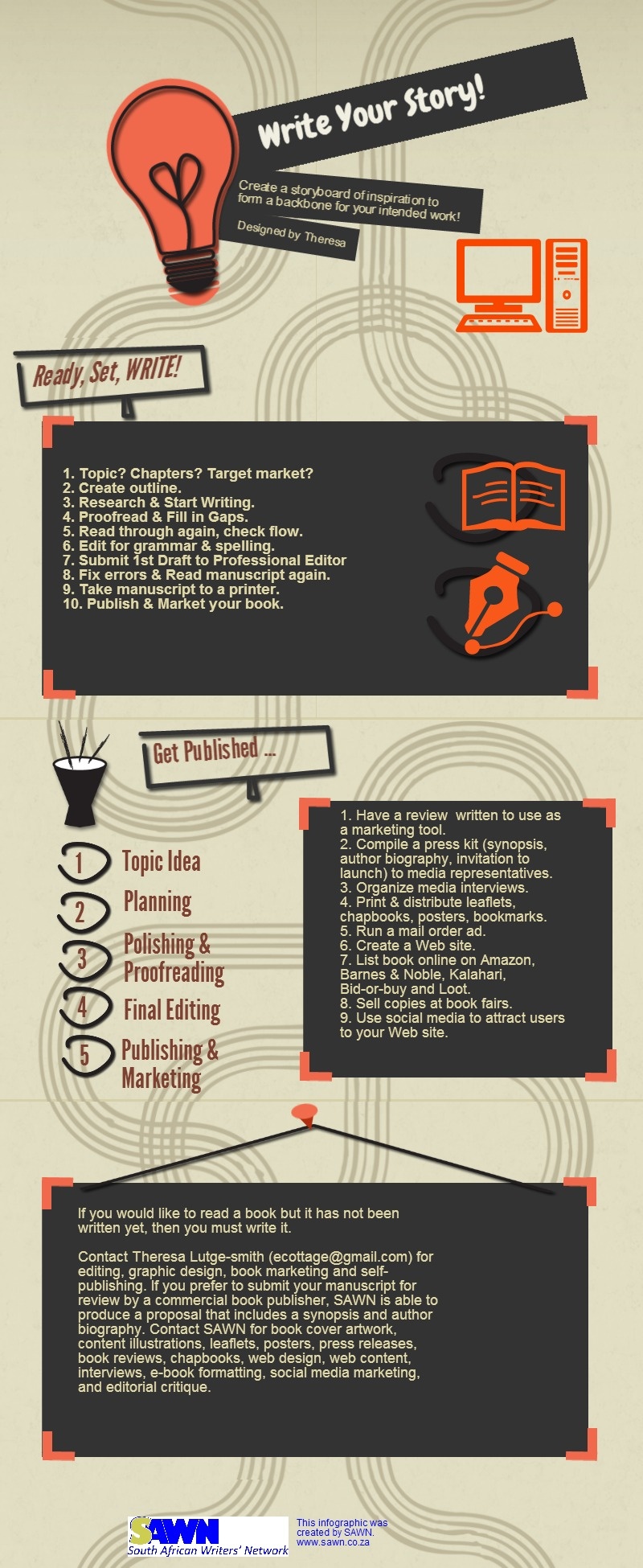
Many people dream of writing a book, particularly those who are of an age where they have collected wonderful memories and a good perspective of life. How would you advise such a first-time writer to proceed practically? Set up a workstation in a corner of the quietest space in your home. If domestic time constraints limit free time it might be preferable to write when everyone else is still asleep (an hour or more before the rest of the household starts their day) or when they are away. If you do write when family members are about, make it clear that you do not want to be disturbed while you are at your computer. It might help to play soothing music on a headset to block out noise. An alternative to a home office is to rent a small office or studio. Carry a notebook and pencil with you to jot down notes and ideas. Spend time browsing magazines and newspapers. Browse the Internet to keep abreast of emerging trends. Become an avid reader; expand your general knowledge on diverse topics. Talk to people and ask what they are interested in. Writing a compelling story or non-fiction is hard work and it helps to have a reliable PC or laptop with an ADSL connection at your disposal. The sheer range of information and opportunities on the Internet to help writers is staggering. Once you are clear about what your proposed book is about, create a framework by making up a list of the various areas you will explore; this will help keep you focused when gathering information. Try to maintain a set routine for working on your manuscript, for instance, from 5 – 6 in the morning and from 8 – 9 in the evening. You will achieve a sense of personal accomplishment as the manuscript develops.
Are there trends and tips on getting publishers to read your manuscript? Publishers are generally very busy people and receive piles of manuscripts on a daily basis. However, instead of submitting the entire manuscript for review rather forward a concise synopsis/proposal, which is much quicker to read; make sure the content has the power to ignite an editor’s imagination and get them involved in what you are trying to convey. Editors commonly define a book proposal as “an outline and at least two random sample chapters” but what they really want is anything on paper that will give them some sense of how you write and some reason to believe that your subject, when developed, will interest a large group of readers. Since salability is a vital consideration, direct an editor’s attention to several possible markets and suggest ways of reaching them. Talk realistically about similar books in the marketplace and how your book is different. Indicate the breakdown by chapters and sketch your primary sources of information (with whom you will talk, what statistics you will gather). Explain your credentials. Cite publishing credits as evidence of your ability to write, and any experience or training that qualifies you especially well for the chosen subject. Enclose a sample of your text (twenty pages are about the norm) that reflect your book’s content and style. Express any passion you may feel about the project.
What about self-publishing: what are its advantages and disadvantages? More and more writers are opting to self-publish their books mainly because they are unable to find a commercial publisher interested in contracting their work. This is often because the topic is aimed at a small niche market; a commercial publisher looks at a large group of readers. Yet, some writers also choose self-publishing because it allows them more control of the product (design, layout, promotion, marketing and distribution). Of course, the author is responsible for footing the bill from inception to distribution unless they are sponsored. The self-published author also stands to earn substantial revenues from the sale of the publication whereas if they had signed with a commercial publisher, would be paid only a percentage of revenue earned from books sold. Another benefit of self-publishing is that the author retains all rights to the book. However, while self-publishing and print-on-demand has become immensely popular, authors should ensure that the product, from the cover design and content layout to choice of paper and binding is of a standard equal to commercially published books. A poorly bound book printed on sub-standard paper will not find its rightful place in a good bookstore or retail outlet.
What are good topics in the reading market right now? Just as diverse as consumers who buy books so are the topics they aspire to. Topics that are very popular include health and fitness, weight reduction, self-development, making more money, sport, and religion. While cookery books by celebrity chefs like Jamie Oliver are also popular buys income-generating arts and crafts are equally in demand. I’m passionate about business and marketing; one would imagine that nothing new in this arena can possibly be sufficiently innovative to cover 500 printed pages, but knowledge leaders like Charles Handy and Alvin Toffler bring out new editions on a regular basis to feed my interest. I also enjoy reading about voluntary simplicity and self-sufficiency.
How does a would-be author juggle reality with their dreams? We all need positive experiences and emotions to remain inspired. Yet, some days, no matter how hard you try, life rains on your parade, deadlines are missed, computers crash, and tempers fly. Sit quietly in a comfortable couch, relax, breathe deeply, and do absolutely nothing for at least 30 minutes; take a notebook and jot down ideas you have for your writing. Imagine a day in your life, as you would like to live it. Does it leave you feeling good about what you are doing with your life? Create spontaneous time. Walk the dog. Fly a kite. Sit on a park bench and feed the birds.
What are the steps to writing a manuscript?
- Identify an idea or topic, e.g. “The Family Throughout the Ages”, which is a broad concept, will most likely follow a sequential timeline comprised of numerous sub-topics (chapters). Give each chapter an appropriate title. A mind-mapping exercise might help to identify these sub-topics.
- Describe your target market. Plan on writing about 50,000 – 60,000 words.
- Create an outline or framework of your story. Divide each chapter into a “conversation” covering important points and stories you would like to tell. What emotional needs of your target market can be addressed? Transcribe your “conversation” into typed words.
- Once you have a detailed outline start filling in the gaps. Gather additional data and insert into the right chapters. work on each chapter before moving to the next; you may find that it is necessary to move some text to other chapters later on. Read the first draft to see if you need to add, change, remove, or move copy.
- Read through the entire manuscript, again. Does it flow? Are your points clear? Is it interesting to read? Critique it from your target readers’ perspective. Edit to complete the second draft.
- Submit the second draft to a professional editor to read the copy for consistency, flow, and for general editing.
- Finally, to be 100% sure, read through the final manuscript (again). Go get your book printed and bound (perfect binding).
How should a self-published book be marketed? Promoting your book can get expensive. It can also be a bit overwhelming. A good place to start is to have a review professionally written to use as a marketing tool to generate publicity and announce possible book signings. Other PR activities include a putting together a press kit (synopsis, author biography, photo of author holding the book, concise Q&A/interview with author, list of outlets where the book will be on sale, author’s contact details, and invitation to the launch) to media representatives and select guests; set up magazine and radio interviews; print and distribute leaflets or chapbooks (to publish a trailer of the book); display posters in retail stores that agree to stock copies of your book; run a mail-order advertorial in a community newspaper; distribute bookmarks at libraries; showcase the book on a dedicated web site; list your book online on Amazon, Barnes & Noble, Kalahari, Bid-or-Buy and Loot. You could also, depending on the topic, run seminars or workshops on the subject and sell copies to delegates. Use social media to attract users to your web site.
Ideas to promote your business

Promotion is an important element of the marketing mix of any business. There are thousands of ideas to promote your business, whether it is a new start-up or an established concern.
- Revise your marketing plan;
- Revisit your research and development strategy;
- Refine your target audience and unique selling proposition (USP);
- Expand your product and service offerings;
- Update your business cards, website, brochure;
- Write an elevator pitch;
- Rent a booth at a trade show;
- Launch a direct mail campaign;
- Expand your social media management;
- Set up Google Analytics on your website and blog;
- Start a customer relationship program;
- Write a book;
- Design an innovative logo that compliments your business and builds your brand;
- Design branded letterheads, envelopes, business cards and office stationery;
- Design an illustrated brochure or pamphlet that looks professional to explain the benefits of your product or service. Ensure that the print quality is superior
- Register a domain name and create a Web site that draws attention. If possible, include e-commerce capability;
- Get listed on all major search engines; include carefully selected words in your Meta tags that prospective customers might enter during a search when looking for the type of goods or service you provide;
- Advertise in the type of magazines or newspapers your target customers are likely to read;
- Print handbills (leaflets printed on size A6 sheets) and place on car windshields and in mailboxes; or hand out at traffic lights;
- Customize your marketing to niche customers. Talk to potential customers to find out what their needs are, their likes and dislikes, and what they are prepared to pay for a product or service like yours;
- Build a client database to collect information about clients, such as their comments about the product or service, regularity of orders, complaints, etc.;
- Design branded promotional items such as t-shirts, mugs, pens, balloons, calendars, fridge magnets, etc. that can be distributed to customers in your area, at a trade show, etc.;
- Run a special offer on your Web site and mail a complimentary (branded of course) promotional item with each order;
- Sponsor a community event, which will give your business exposure in your immediate community and is a great opportunity for word-of-mouth advertising;
- Consider donating branded t-shirts and caps to an underprivileged sports team; contact the editor of your local community newspaper to request media coverage;
- Build solid relationships with suppliers. Being on friendly terms with them will encourage them to promote your business to other clients;
- Send out a monthly newsletter to highlight new products and specials on offer. You can also send out e-mail messages to locals to visit your store or to place an order online;
- Create (or have a graphic artist do it for you) an attractive point-of-sale display or an eye-catching poster. This will attract the attention of pavement traffic and get them into your store;
- Initiate a telemarketing campaign. Write a to-the-point opening and rehearse it well so that when you make a call the words are spoken from memory (and come across as sincere) and not read like a robot. Even when making cold calls, just be yourself; start with a friendly greeting and introduce yourself and your company. Briefly describe your product or service and relevant benefits, and where your store is located;
- Identify cross-promotional opportunities by seeking other businesses that are not direct competitors, but whose products or services compliment yours. The idea is to combine products or services from various sources to make up a comprehensive package that customers want and offers them convenience; you can do a promotional deal that will benefit all participating businesses. An example is a Pizza Take-Away next door to a Video Store; or a Coffee Bar next door to a Book Store;
- Write generic editorial about your industry for publication in a local or community newspaper. The article should not be specifically about your business, but about developments within your industry. Make sure the content is interesting, with variable facts, and that you get accreditation as the writer. This way reader’s will identify the information with you as an expert on the subject. Include your contact details so that readers may get in touch with you if they have questions;
- Running a competition is a great way of attracting attention and getting feet into your store. Include a feature of the competition that obliges participants to come to your store;
- Include promotional material and price lists with your customers’ purchases, when invoices are sent out, announcing a new product or service, competition, etc.;
- Take part in relevant trade shows, seminars and exhibitions, which are all great opportunities to network with suppliers and prospective customers;
- Signage on company vehicles is mobile advertising that is seen by many prospective customers wherever you travel or park. Don’t clutter the design; keep the information straightforward and easy to remember–basically your business name, logo and contact phone number;
- Placing a sidewalk sign on the pavement in front of your store will get you noticed. The sign should bear your logo and perhaps a special offer that will entice customers to visit the store;
- Get signage in the vicinity of your business to alert customers about your existence. A free-standing mini billboard or framed poster placed in prime positions, with an arrow pointing in the general direction of your store, will attract attention;
- Advertise an organized lecture-demonstration about your product or service to be held at a set time; make full use of this opportunity to impress prospective customers by addressing their queries, identifying solutions to their problems, and distributing product sheets and branded promotional give-away’s;
- Request that customers and prospects complete a short questionnaire so that you may subscribe them to receive a free monthly newsletter telling them about developments in the industry, new products and specials. Stress that they are under no obligation to purchase;
- Have an edition of branded wall or desk calendars printed to hand out as gifts to customers, towards the end of the year;
Contact Theresa (ecottage@gmail.com) for writing, editing and design.
Frugal people enjoy life!

It is apparent that frugal people enjoy life because they are not burdened by debt; they pay their bills and have some money left over for savings. Living frugally does not mean doing without; it’s about not accumulating unnecessary material possessions. It’s about deciding what you want in life, and making the most of what you have, instead of complaining about what you don’t have. Frugal living is a very rewarding way to live. An effective way to start saving is to deposit at least 10% of your income in an interest-bearing savings account. Get rid of debt and trim your expenses. Can you save on petrol? Can you restrict eating out? Can you live without DSTV? The basis of Frugal Practicality lies in re-thinking life choices up to this moment to embrace a lifestyle that is more financially responsible and organized. This does not mean adopting a “poverty” mindset but rather maximizing what you have got. Create a budget plan and stick to it; don’t waste money on things you don’t need or buy things on credit, but don’t skimp on things you do need. Be alert when grocery shopping; opt for the generic equivalent of brands you normally choose or store specials. The same applies to clothing; avoid expensive brands when you can buy similar items of equal quality for less.
Adopt a habit of recycling and reusing. We all know that we should become debt-free but many of us don’t know where to cut corners. Initiate a frugal lifestyle one step at a time; prepare a healthy lunch box at home to take to work; organize a lift club to commute to and from work; plan shopping outings to avoid random trips. De-clutter your home; sell or donate items you don’t use. Hold a yard sale; auction items online; sell to second hand shops. Small lifestyle adjustments can make a big difference in your bank account. Cutting expenses allows you to save money for an emergency, pay off credit cards faster, or grow your retirement fund. Run your washing machine on cold. Avoid using the tumble dryer. Turn down the thermostat on your geyser.
Make inexpensive healthy meals; according to the “food pyramid” many of the things we should be eating the most of — grains, legumes, fruits and vegetables – are affordable; it’s often the stuff that’s bad for us (at least in large quantities) like red meat, dairy products and processed foods that are expensive. Grow your own fruit, herbs and veggies; a personal favorite of mine is upside down tomato planters. You’re probably thinking why anyone would want to grow tomatoes (or anything else) upside down. Well, there’s no need to stake the vines, no weeding, fewer soil diseases, overall healthier plants, and you can grow year-round. All you need is a 5 gallon bucket, a plant, and a bag of potting soil. Drill a big enough hole in the bottom of the bucket to fit the stalk of a full-grown tomato plant. Cover inside of bucket with a layer of shredded newspaper. Insert the plant in the hole (from the outside); wrap paper around the base of the plant and hold in place while filling bucket with soil. Hang bucket in sunny spot, water well. Peppers, chilies, cucumbers and eggplants also grow well upside down. Spray plant with a solution of 1 teaspoon Epsom salts dissolved in 4 cups warm water (mixed in a spray bottle); repeat 10 days later – it produces more fruit due to the boost of magnesium, especially for tomatoes, peppers and roses.
Words by Theresa Lutge-Smith (ecottage@gmail.com)
Starting a Green Business

Starting a green business means you will be running a business targeting a growing market while making a valuable contribution to making the world a better place. It’s also a practical way to help create a more environmentally friendly and sustainable economy.
Ideas for a green business:
- Eco-friendly Dog Shampoo
Commercial pet shampoos, both cat shampoos and dog shampoos, contain a startling amount of chemicals and non-natural ingredients; some include artificial scents and colors, and even sodium laurel sulfate! Why not mix a shampoo that is gentle and natural. Ingredients for a Natural Homemade Dog Shampoo: a cup of all natural organic liquid soap; a cup of pure organic apple cider vinegar (the best way to treat ringworm, fleas, ticks and helps rid the coat of any and all skin conditions); a third of a cup of glycerin; and a quart of water. Mix these four ingredients together, pour into a bottle. You now have your own all-natural dog shampoo. Give your bottle a good shake before use to mix the glycerin thoroughly. Design a creative label for the bottle; attach a tag that lists the ingredients and method of use. Sell to pet stores, supermarkets, pharmacies, veterinary clinics or by mail order.
- Organic Gift Baskets
Buy a selection of earth-friendly items wholesale, such as teas, soaps, shampoos, facial scrubs, organic snack food, a biodegradable flower pot and a packet of culinary herb seeds; plus baskets and natural raffia to create gift baskets. Create several themes for your gift baskets. Gift baskets are sold as ready-made gifts. Sell them to pharmacies, hotels (to give to guests), gift shops, corporations (as gifts for their customers), health shops, hospital kiosks and by mail order. Package miniature gift baskets containing small-size items such as waterless hand sanitizer, hand lotion, and a toweling cloth to market as promotional hand-out’s at trade shows/conferences/seminars/filling station kiosks.
- Want to start a green burial business?
Use seed-embedded handmade paper to construct a cremation vase (pillow box or pyramid box) ideal for water or land burials. The seeded paper is made from 100% recycled paper, which is biodegradable and environmentally safe. The vase will disintegrate when buried in soil; the paper is embedded with Marigold flower seeds (bright yellow and orange blooms) or herb seeds and will yield a patch of flowers/herbs in your garden to commemorate the loved one’s memory. Unseeded handmade paper is used to construct the cremation vase for a water burial; the bio-degradable box begins to sink within 10-15 minutes and will fully degrade within a day. These are more valued options to simply scattering ashes in the wind. Contact Theresa (ecottage@gmail.com) to order pre-cut and scored templates of the pillow or pyramid box for quick and easy assembly (flat packed). The paper vases (boxes) are suitable for adult, infant and pet ashes. Read More.
Families in Crisis!
We live in a country that is becoming increasingly diverse in cultural, ethnic and socio-economic backgrounds. Yet despite significant development milestones South Africa still generates enormous waves of negative energies attributable to poverty, indifference, resentment, corruption and greed. Many families are in crisis; family members live in fear of violence, assault and robbery, and are constantly watchful of their safety. Similarly, the pace of our capitalistic existence has become almost unbearable, with many families hopelessly entangled in a continuous cycle of debt and poverty. Accordingly, stress has for many households become a recognized and socially destructive illness in South Africa, affecting citizens of all ages in different ways.
While raising and educating children is a challenge for most parents, the situation is especially difficult for families experiencing social and economic hardship, particularly single-parent households. The traditional two-parent family has by and large been replaced by the single-parent (usually the mother or grandmother) family; the percentage of female-headed households with children has increased most rapidly among our black population. The downside is that female-headed households become overburdened and struggle financially to make ends meet; juggling work, limited resources and family life impinges on quality time devoted to children’s basic education, family values, and other important family obligations. Statistics show that males are inclined to have little reverence for the females that raised them; and instead of gratitude and respect develop contempt for females in general.
Some blame the escalating level of delinquency, depression and aggression in the country on the ever-expanding norm of fatherless homes, where children are raised by mothers and grandmothers and have no father-figure to impose constructive discipline. Without discipline and boundaries children lack the tools necessary to navigate relationships and challenges in life such as self-discipline, respect for others, and the ability to cooperate with peers. Failure to discipline children often results in kids who are unhappy, angry, and even resentful. This often leads to drug and alcohol abuse and violent crime such as sexual assault; these children grow up with deep emotional scars because they feel forsaken. I don’t believe a parent intentionally neglects their child; they may simply be in the midst of their own traumas and chaos, such as an addiction, an abusive situation, poverty or disease. It may be that they don’t have the tools to be a dependable role model. The African proverb, ‘It takes a village to raise a child’ succinctly articulates the powerful notion of collective responsibility towards our youth, but children raised in a healthy, two-parent home fare best.
A low-income parent is more likely to engage in inconsistent parenting practices; the economic well-being of the family rests on the mental and emotional health of the single-parent since financial strain intensifies stress, anxiety and depression. Yet despite these overwhelming disadvantages, the birthright of every person is access to constructive opportunities devoid of discrimination to gender, ethnicity, socio-economic backgrounds and disability.
Words by Theresa Lutge-Smith. Contact Theresa (ecottage@gmail.com) for any writing and editing.
Improved Longevity in the 21st Century

The pharmaceutical industry is at a pivotal point in its evolution, particularly in relation to research and development. New hyper-efficient technologies create a greater understanding of underlying biology of the human body and its susceptibility to disease; this provides a visionary perspective for the 21 st Century pharmaceutical engineering-sector to set a “collaborative” model of health care (information sharing to deliver optimal patient care), not only to explore greater opportunities for the development of truly innovative products but also to employ a lean manufacturing approach to eliminate waste , and boost output and cost-effective outlay. In order to best utilize viable opportunities that these strategies embody, today’s pharmaceutical manufacturer must endorse the operational changes needed to improve speed of response for the differing types of innovative treatments, and the impact of migrating from the current linear phase R&D process towards in-life testing and live licensing (cumulative testing of the drug throughout its life cycle) if it is to collaborate more closely with regulators and health care providers about pricing and demonstrate outcome benefits and value for money. There is no doubt that the quality of pharmaceuticals will be improved dramatically.
Corporate Responsibility
The modern pharmaceutical industry, which originated in the mid-nineteenth century, evolved exponentially to the final decades of the 20th Century. Impressive high-tech developments in medicine await us in the 21 st Century that will make contemporary medicine seem relatively primitive. However, it’s apparent that ground-breaking pharmaceuticals will not only have a “high-tech” side but also a “high-natural” side due to a growing popularity in self-care, wellness, alternative remedies, and new understandings of body-mind connections for treating acute and chronic conditions. Self-care practices have grown considerably in the past decade and even faster growth is projected for the next decade. Since health care expenditures are expected to grow faster than national income over the foreseeable future — exacerbated by high unemployment and lower incomes for many South Africans — self-care will not only be important for encouraging better health but also for saving money. Wellness programs initiated by many corporations have also experienced impressive growth in the past five years. An integral part of in-house (corporate) health care is to provide employee’s access to a resident registered nursing sister who is tasked with monitoring routine health checks. Health behaviors or conditions that warrant monitoring include blood pressure, cholesterol, diabetes, and HIV/AIDS; health programs help employees manage chronic ailments such as arthritis, asthma, back pain, osteoporosis, stress and depression.
Is DIY testing conclusive?
Home testing kits, readily available from chemists or via the Internet, claim to be able to detect the early warning signs for conditions ranging from Alzheimer’s disease to prostate cancer. But should such tests be carried out without proper medical guidance and support? And are the results conclusive? DIY testing kits for potentially life-threatening conditions such as stomach ulcers, prostate problems, bowel cancer and diabetes can be misleading; some test results give false reassurances while others cause unnecessary panic. Consequently, people may be better off going straight to their GP or clinic.
Collaborative Health Care
The anticipated “collaborative model of health care” will demand that high-tech physicians collaborate with various high-touch health practitioners, to convey a holistic prognosis. With technology such as emails, instant messaging, and social networks, there is little doubt that patients might soon be speaking directly to their pharmaceutical manufacturers about product information, instead of their doctors or other medical professionals.
Take Responsibility for your Health
After remaining fairly constant for most of human history, life expectancy has nearly doubled in the past century. The maximum life span has increased spectacularly as well. Scholarly opinion diverges, however, as to whether these increases will continue or whether human longevity is approaching its limit. Improved health care, sanitation, immunizations, access to clean running water and better nutrition are credited with the massive jump. A better understanding of hygiene and the transmission of microbes has contributed substantially to public health. What about Life expectancy in the future? Some researchers predict that HIV/AIDS and lifestyle factors such as obesity will halt, or even reverse, the rise in life expectancy. AIDS-defining causes of death include liver cancer, lung cancer, gastric cancers and virus-related cancers, while people living with HIV/AIDS increasingly face homelessness and mental health issues, including substance use. Obesity and its complications (including cholesterol, gallbladder disease, and arthritis) could well reduce life expectancy at all ages in the first half of the 21 st Century. Yet, living longer makes us vulnerable to “age-related diseases” such as coronary artery disease, certain cancers, diabetes and dementia. Many of these conditions can be prevented or at least delayed through healthy lifestyle choices like following a balanced diet, maintaining a healthy weight, exercising regularly and keeping stress at bay.
Question everything!
It’s important to question and understand your doctor’s advice. Know what medications you are taking; this includes herbal or nutritional supplements. If you are facing a health crisis, seek another opinion. There may be an alternative to prescription drugs, e.g. change in lifestyle. When you’re in the hospital, make sure you know what the nurses are putting in your IV. Watch out for infections; when dealing with health care practitioners, check that they wash their hands and stethoscope before examining you. Verify your prescriptions; ask what the drug is, the dosage, what it does, how to take it, and possible side effects. Write this information down! Listen to your body; if you feel that something isn’t quite right, go back to the doctor or get a second opinion. If you are having surgery, talk to the anesthesiologist the day before. Seek out alternatives; there is often a natural or alternative option. Many people are taking a more active role in their health by carrying out DIY testing and recording the results. Communicating the frequency of asthma attacks or the results of diabetes home testing can allow your doctor to make a more informed decision on your treatment. Embrace opportunities to stay informed about health issues, including malnutrition, malaria, intestinal infections and HIV/AIDS.
Copyright: Leaders in Wellness (magazine)
Words by Theresa Lutge-Smith (ecottage@gmail.com)
How to Boost your Business Marketing

Business marketing in an economic downturn demands a critical re-examination of your existing marketing plan and finding low-cost yet effective ideas to remain profitable. While it may seem logical to cut back on advertising and promotions during a slow economy, it is essential to keep your business name and logo in the public eye if you want to be perceived as successful, reliable and enduring. The solution lies in identifying smart alternatives that will help your business achieve this objective. Savvy marketers suggest that instead of ‘playing it safe’ by cutting back on your advertising budget you should rather initiate a campaign to rejuvenate your marketing strategy. However, in order to be effective these low-cost ideas need to be creative, unique and original. First, start by re-evaluating your target market to find out who exactly is buying and why; it’s also critical to identify which advertising options work best in generating sales in a downturn economy and then increase the budget for these options while reducing other ‘business as usual’ areas. Second, re-focus by rethinking your marketing mix and adapting your plan of action but not the overall budget. You may want to boost your business by launching a PR and Publicity campaign, which should include sending out press kits to relevant media for publication; make sure the press releases are newsworthy and that your focus is to connect with customers’ needs while at the same time promoting your brand image.
Low-cost marketing ideas in a downturn economy:
1. Embark on a market research campaign to re-acquaint yourself with your industry. Gaining a fresh perspective of consumers’ expectations will be worth the time and expense and provide new opportunities to establish a relationship with investors, suppliers, customers and prospects. Consider exploring new opportunities such as ‘going green’ or ‘frugal practicality’ to boost awareness of your business.
2. Update your web site on a regular basis to showcase your business. Offer time-sensitive special discount deals. Also include information rich content that provides solutions to problems associated with reduced disposable income; people are always looking for ways to stretch their budget. Create links on your site that enables prospects to download free information (catalogue, price list); make sure the download is linked to special offers on your product or service. Keep a database of customers’ personal information; send them electronic holiday cards, birthday wishes, newsletters and notices of special offers and sales. A good way to collect personal data is to include a registration card with your product to capture the name, address and other information about your customers. Ask their permission to forward material to their email address.
3. Join social network groups on the Internet. This will provide the opportunity to communicate market-related information to potential consumers. Networking with consumers through this medium also opens doors to new markets at little or no cost.
4. Increase your involvement in community or charity work. Your business name will receive valuable exposure and offer opportunities to receive free publicity. People are generally prone to supporting businesses that give back to their community.
5. Corporate gift giving is your opportunity to make a lasting impact on customers. When most businesses are cutting back on giving branded gifts to customers, now is your chance to make an impression with a unique corporate gift. An effective corporate gift need not be expensive, but it should be memorable. Besides, it’s the thought that counts.
6. Hand out seed-embedded calling cards. Handmade from recycled paper, these calling cards are embedded with seeds (to grow a patch of flowers or culinary herbs). The card is attached to a standard printed business card so that the recipient can remove the section that contains the seeds while retaining the other section with your name and contact details. The idea is for the recipient to plant the seeded section of the calling card in soil and watch the plants grow.
7. Distribute door-hanger calling cards to homes in your target area. These door-hangers, printed on 300gsm stock board and die-cut to fit over a door knob, include relevant information about your business. Include eye-catching graphics and perhaps a catchy slogan. Contact Theresa for a design and printing quotation.
8. Advertise your business through your voice mail message. Take time to write a catchy script for a phone message or voice mail that communicates to the caller in a professional yet friendly manner. In brief, inform the caller who about your business and specials on offer. When people call during closed hours, this may be your only opportunity to tell them about your products or services. Consider allowing the caller to leave a short detailed message and their phone number so that you may return the call.
9. Hire reliable people to place flyers on windshields of vehicles stationed in parking lots. Many motorists regard windshield flyers with irritation and it is therefore important that your flyer offers something of value, like a discount coupon for your product or service or free consultation. You could also include a seed-embedded insert with your flyer to promote a slogan or theme to highlight your business promotion.
10. Create custom-designed place mats (or coasters, napkin holders) printed on stock board (300gsm) for local restaurants that incorporates your creatively designed advertisement. Approach owners of café tearooms, sandwich shops, coffee houses and pizza parlors to offer free paper place mats (or coasters, napkin holders) for their tables and trays. The artwork should include your company name, contact details and possibly a discount coupon. Consider also including advertising copy promoting other businesses in the area and share the cost of printing. Contact Theresa for a design and printing quotation.
11. Use your car to advertise your business. You can advertise your business wherever you drive or park your vehicle. Put on magnetic signs on the car doors. Create a custom auto sunshade from a length of sturdy cardboard that you can prop up against the windshield whenever the car is parked; create eye-catching artwork that incorporates your business message and contact details. Contact Theresa for a design and printing quotation.
12. Get the customer’s attention with creative in-store. Add colourful ‘shelf talkers’ signage hanging on the edge of the shelf below. Spraypaint graffiti-looking signs on walls. Hand out custom printed inflated balloons. Contact Theresa for a design and printing quotation.
13. Mount a bulletin board where it is clearly visible to customers. Invite customers to post personal advertisements on the board to build goodwill; also utilize the space to put up posters promoting your business and events sponsored by your enterprise.
14. Create a slogan that is memorable and instantly tells people who and what your business is, and lets people know where you are. Use the slogan in all your print advertising and marketing communications.
15. Make your in-store restroom facilities a pleasurable experience for customers. Keep the facilities neat and hygienically clean, well stocked with toilet rolls and smelling great (opt for an industrial air freshener). Consider feeding some tranquil background music into the restroom. Give customers something to read by displaying a creative and humorous poster on the inside door that reminds them what products and services you provide.
16. Provide customers with some reading material or something to listen to while they are waiting in line. Occupying their time in a constructive manner will help reduce anxiety and put them in a better mood. Besides making magazines available to bide their time, consider placing comfortable chairs and couches throughout the store so that the elderly, spouses and children can relax while the other family member shops. You could even create a lounge area with couches, magazines and a large TV screen in the back of their store for weary shopping partners.
17. Reward employees for great customer service, and empower them to offer suggestions on how to improve performance. A very high number of customers are lost to poor performance or bad attitude. While business owners don’t have time to supervise every customer transaction, regular in-store training to motivate and develop skills is important. Create an anonymous suggestion box, which only you, the manager, can open. Have your employees wear name tags so that customers can identify them.
18. Create a store newsletter and include photographs of regular customers and a short interview in which they express positive comments about your business. Provide incentives to increase business, for example, extended business hours, free parking, discounts for senior citizens, or an in-store child-care facility.
19. Place a friendly employee at the entrance door to welcome customers to the store, pull out a shopping cart, answer queries they might have, direct them to sales items, or present them with an in-store leaflet. The host or hostess at the entrance door also acts as a security guard. Utilize this opportunity to collect critical data about what kind of customers visit the business (age, gender) and the type of questions they ask.
20. Create a short after-hours phone message to give customers information about your business they might find valuable. For example, “Thank you for calling Swift Renovators. We’ll be open promptly at seven-thirty tomorrow morning to serve you. Our business hours are seven thirty a.m. to six p.m. Monday to Sunday. To leave a message of any length, press 1 now. For store location and directions, press 2. For an update on new products and current sales, press 3.”
21. Offer a self-serve gift wrap service. Equip a table with a selection of wrapping paper, ribbon, cello tape and scissors. Consider selling gift certificates, which can be gift wrapped in a box.
22. Direct Mail Marketing: Put together a selection of pamphlets, discount vouchers, booklet bookmarks and a product brochure, plus a small free gift, and mail to customers and prospects. Contact Theresa for a design and printing quotation.
23. Print official-looking invitations and send to customers and prospects to announce a sale, grand opening, seminar or other event. Contact Theresa for a design and printing quotation.
24. Make up a ‘welcome kit’ to send to new customers, containing a product brochure, calling card, discount vouchers and a promotional gift item, plus a print card welcoming them. Package the kit in a unique ‘envelope’ or container (something that personifies your business) to create interest; such as an empty paint can, oversized greeting card or plastic envelope, CD Jewel case, large brown paper bag, Have the ‘envelope’ delivered to their door by courier so that the recipient has to sign for it.
25. Include a product leaflet when you send your invoices to customers, it’s likely to prompt repeat purchases.
26. Check your local newspaper for new business prospects.Newspapers list business ownership changes; send the new owners a short note of congratulations, a gift certificate for your services, and a calling card. Contact Theresa for a design and printing quotation.
27. If your business makes house calls, such as an electrician, plumber, builder or painter, send postcards to homeowners in the area letting them know what service you provide. For instance, a card from a building contractor might say, “Our team just built your neighbor’s fourth bedroom and painted the exterior of the home at 11 Montgomery Street. The respective jobs costs less than you think and are guaranteed for 10 years! If you like what you see, give us a call for a free estimate.” Most tradesmen post temporary signs in their customers’ yard while they’re working on the house.
28. Before organizing to exhibit at a trade show, advertise a special contest or in-store event to publicize the exhibit and to draw attendees to your booth. For example, you could advertise a lucky number draw to win prizes or a free video presentation at your booth. Run advertisements in the local newspaper about the forthcoming trade show and promote your booth. Negotiate with the trade show management to share the costs of running the ad campaign, which will attract attendees to their show. Send out personal invitations to customers and suppliers to attend the show; you may want to include a gift voucher so that they can redeem a gift at your booth. Dress up an employee in a costume to represent the company mascot and walk the halls and isles of the trade show to entice attendees to visit your booth. Offer trade show attendees branded tote bags to hold show literature, which will advertise your company as they walk through the aisles of the show. Give away branded t-shirts at your booth if the recipient agrees to put it on right away, thus advertising your company and product.
29. Promote your product or service by exhibiting at local church or school fairs, and flea markets. Place a small ad in the local newspaper. While you could man the booth yourself, you might want to exhibit your product with another vendor’s product.
30. Instead of having a storefront in a mall and pay high overheads, consider opting for a short-term rental agreement to put up a temporary mobile booth in a strategic position within the walkway of the shopping mall. A good time to exhibit is on the weekend or during special promotional events that bring traffic into the mall.
31. Celebrate your business’ birthday by inviting customers and the media for an in-store celebration and a sale.
32. Present customers with free promotional items that tie into a holiday celebration or product launch.
33. Customers value receiving ‘something extra’ in appreciation of their making a major purchase. Giving them something that adds value to their purchase builds a relationship with the customer. For instance, if the client has purchased a lounge suite, present them with a floor rug or scatter cushions to compliment their purchase. A plumber can give every customer a sample bottle of liquid drain cleaner or air freshener as part of house calls. An auto repair shop can do a complete valet service before the vehicle is delivered to the customer.
34. Re-use and re-cycle where possible. Make your packaging reusable. Let your customers know that you encourage re-using packaging materials by printing the corporate logo on recycled materials. Contact Theresa for a design and printing quotation.
35. Encourage customers to become active participants in the development of your business. By involving customers in the process and taking cognizance of their suggestions you build mutual trust and ensure that your service is a memorable experience for them.
36. Create a smart dress code for people working in the business. The style of dress need not be expensive or high fashion; it is important that employees are comfortable and confident wearing the garments. A good choice is tailored trousers for gents and either trousers or knee-length skirt for ladies. A soft-collar golf shirt is appropriate and casual for both men and women. Have your company logo machine embroidered on the front pocket of the shirt.
37. Make sure that the interior and exterior lighting of the store is adequate. Customers tend to buy more when an establishment has good lighting and products are clearly visible. Your company signage should be especially prominent at night, including well-placed ground lighting to light up the outside walls.
38. Put customers in a good (purchasing) mood by broadcasting uplifting music in your store.
39. Know what your competitors are doing at all times. Make a point of visiting similar stores to compare what they are doing that you can copy or build on. As yourself how you can stand out and provide a better product or service.
40. Sell custom merchandising such as t-shirts, caps, sweatshirts, mugs, towels and tote bags with your company logo screen printed or machine embroidered on them. Have you staff wear the logoed garments to remind customers that the items are available to purchase. Your employees will be walking advertisements in and outside of the store. Be prepared to sell the advertising merchandising at cost price or just above, bearing in mind their value in advertising your business. It is however important that the items are of a high quality as this reflects on the perceived equivalent standard of the business. Contact Theresa for a design and quotation.
41. Changing the name and image of your business could mean a complete turnaround from a struggling concern to a highly visible and prosperous enterprise. Choose a name that is unique, memorable and one that conveys a definite need. Changing the name of the business warrants re-evaluating the original business plan and spending quality time re-thinking the position of the business, its image, and objectives, marketing mix and development strategies, and auditing your customer service. You may need to upgrade the product itself or even expand the range; in order to provide a more comprehensive value product consider combining your product or service with another to create a package that has more marketability. Keep your employees informed (usually by memorandum) of any changes that are incurred in creating a new product so that they are thoroughly knowledgeable when taking to customers (training manual).
42. Create an informal refreshment bar in your store so that you may offer free beverages and snacks to your customers. This gesture builds goodwill for your company and can differentiate you from your competitors.
43. Utilize the expertise and talents of your employees to give a special service to customers. Can an employee play a musical instrument, do miming, tie balloon animals or create visuals on computer to design furniture layout?
44. Every employee should have his or own batch of calling cards. These should be handed to relatives, friends and other prospects. Contact Theresa for a design and printing quotation.
45. Create a fair quantity of pamphlets that contain useful information about your business. Include your company logo, eye-catching graphics or photographs, a description of what the business offers, and phone numbers on the front and back of the pamphlet. Purchase a number of acrylic display cases to hold the pamphlets, and place these on the counter at doctors and dentists waiting rooms, auto repair shops, hairdressers, real estate agents, etc. Put a sticker on each acrylic case that says ‘Free, take one. Contact Theresa for a design and quotation.
46. Create an event in front of your store to increase foot traffic and attract people to your store; alert the media to get your event mentioned in the local newspaper. Examples of traffic-increasing events include the following:
– Invite a musician to play the violin or cello in front of your store entrance.
– Commission an artist to make sketches of people posing for a portrait.
– A mime or clown could entertain passersby.
– Drama students could present short puppet show skits.
– The company mascot could make candy floss using a candy floss machine.
47. Increase the visibility of your store during a sale by using bunting or helium balloons tethered to a rope, mascots, banners, and a red carpet leading into the store.
48. Set your business above the competition by producing a custom published booklet that contains content-rich information about your company and products to strengthen your communication efforts and develop relationships with your target markets. A custom publication serves to separate your brand from the competition, build customer loyalty, and boost the prospect of sales from both existing customers and prospects. Contact Theresa for a design and quotation.
49. Have a giant cake or pizza made and invite customers to sample a slice. You may even want to make this a weekly event exclusively for pensioners’ shopping.
Words by Theresa Lutge-Smith (ecottage@gmail.com)
About Theresa
 I’m a published author of four business books and have written a number of self-study tutorials [creative writing; editing and proofreading; business writing; and self-publishing] and an eBook [Workplace Harmony]. I am an experienced writer, editor and publisher.


Infographics

Bizculture

